The Philosophies of ANEVRA
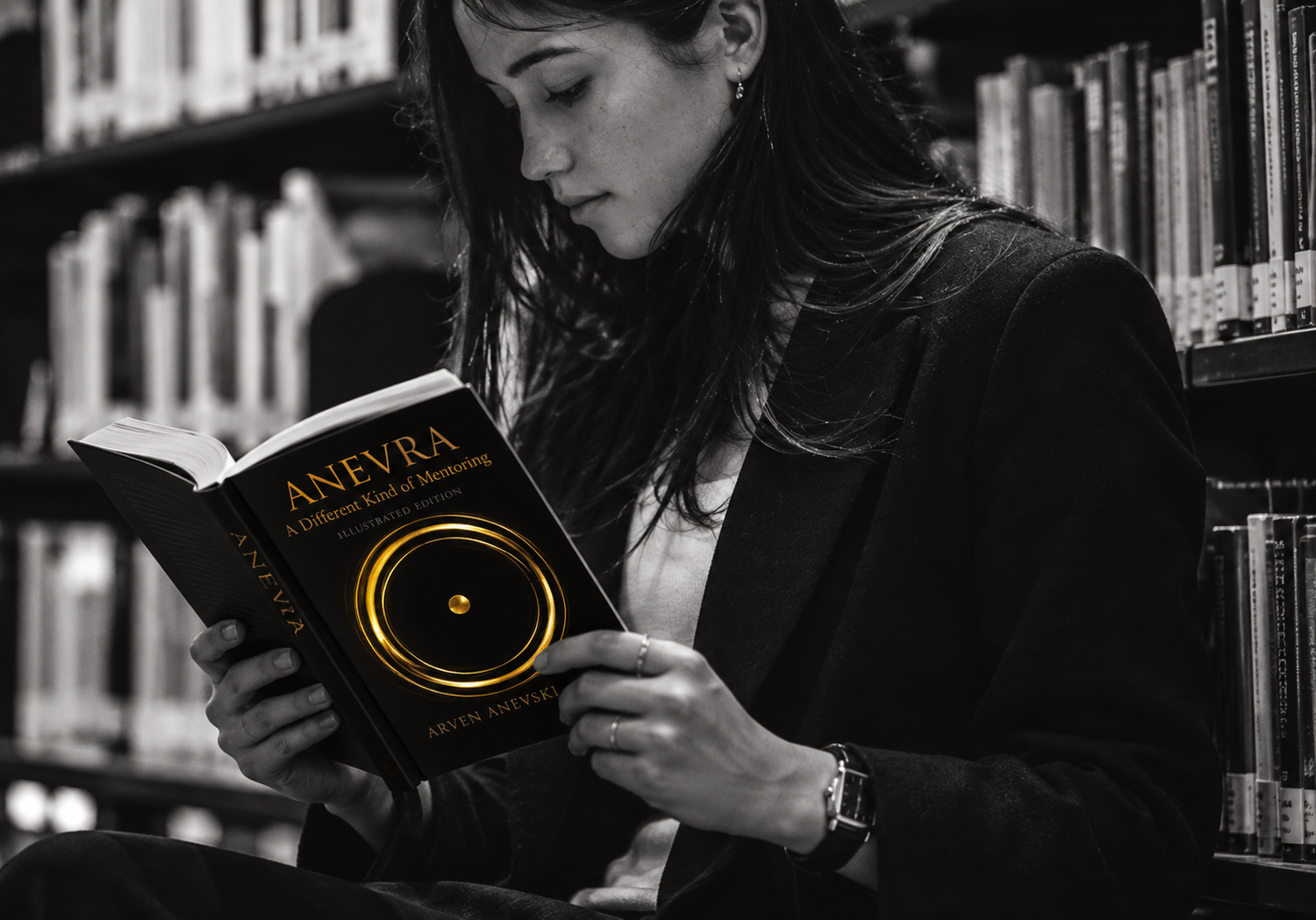
ANEVRA - A Different Kind of Mentoring by Arven Anevski
At its heart, ANEVRA is a philosophy of belonging, compassion, conscious choice and shared responsibility. It invites us to reconsider how we understand ourselves, how we treat others, how we treat other life on the planet, and how our decisions affect the wider world.
Rather than prescribing what people should believe, ANEVRA offers a different kind of mentoring: it encourages us to question, reflect and discover our own answers. Its central philosophy can be expressed in two words: No Other.
The 10 core philosophies
1. No Other: The philosophy of belonging
2. The Unfinished Circle: The philosophy of inclusion
3. Emotion Is Information, Action Is Choice: The philosophy of emotional responsibility
4. Compassion Without Surrender: The philosophy of understanding
5. The Four Transformations: The philosophy of possibility
6. Responsibility Extends Beyond Intention: The philosophy of consequences
7. Power Requires Wider Awareness: The philosophy of ethical leadership
8. Difference Does Not Require Division: The philosophy of coexistence
9. Humanity Is Part of a Larger Living World: The philosophy of interconnectedness
10. Questions Before Conclusions: The philosophy of mentoring
ANEVRA - 10 Core Philosophies

1. No Other: The philosophy of belonging
No person should lose their fundamental human worth simply because they are different, disagree with us, or fall outside our familiar groups.
ANEVRA challenges the boundaries we create between us and them.
Central question: Who have we left outside the circle?

2. The Unfinished Circle: The philosophy of inclusion
Belonging is not a finished achievement. It is an ongoing responsibility to notice those who remain unseen, unheard or excluded. The Empty Chair is revisited throughout ANEVRA.
The circle must remain open to people, future generations and the living world.
Central question: Who is affected, but absent?

3. Emotion Is Information, Action Is Choice: The philosophy of emotional responsibility
Our emotions deserve attention, but they need not dictate our behaviour.
Anger can reveal injustice without becoming cruelty. Fear can signal danger without preventing courage. Grief can deepen our capacity for compassion.
Central principle: We may not choose what we feel, but we can choose how we respond.

4. Compassion Without Surrender: The philosophy of understanding
Compassion does not require agreement, forgiveness, the removal of boundaries or the acceptance of harmful behaviour.
We can understand another person's humanity while still challenging their actions.
Central principle: Judge actions without erasing persons.

5. The Four Transformations: The philosophy of possibility
ANEVRA explores four pathways through difficult human experiences:
Grief to Compassion; Anger to Peace; Division to Belonging; Fear to Courage
These are not guaranteed outcomes or instructions to suppress emotion. They are possibilities that emerge through awareness, reflection and choice.
Central question: What if grief, anger, division and fear were not allowed the final word?

6. Responsibility Extends Beyond Intention: The philosophy of consequences
Good intentions do not automatically produce good outcomes.
ANEVRA encourages us to consider not only what we intend, but also who may experience the consequences of our decisions. This applies to individuals, leaders, institutions, governments and societies.
Central question: Who will carry the consequences of this choice? Other people, animals, future generations?

7. Power Requires Wider Awareness: The philosophy of ethical leadership
The greater our ability to influence others, the greater our responsibility to consider those who may be affected.
Leadership is not simply about authority, achievement or efficiency. It is also about listening, accountability and recognising people whose voices are missing.
Central principle: Power widens our circle of responsibility, not narrows it. Stand in the future and look back.

8. Difference Does Not Require Division: The philosophy of coexistence
We do not have to think alike to belong together.
ANEVRA makes room for different beliefs, cultures, experiences and perspectives without insisting that disagreement must become hostility. Belonging does not mean sameness.
Central principle: We can remain different without becoming enemies.

9. Humanity Is Part of a Larger Living World: The philosophy of interconnectedness
Our responsibility does not end with the people we know, or even with humanity.
ANEVRA widens its consideration to animals, ecosystems, the environment and generations not yet born.
The choices we make today can shape lives that have no opportunity to participate in those decisions.
Central question: What responsibilities do we have toward those who cannot speak for themselves?

10. Questions Before Conclusions : The philosophy of mentoring
ANEVRA does not demand belief or obedience.
It recognises uncertainty, encourages intellectual humility and allows readers to disagree.
Its purpose is not to replace the reader's judgement, but to deepen it.
Central principle: Do not simply ask what to think. Ask how you are thinking.
BEFORE ANEVRA
The Circle Was Already Open
By Arven Anevski, in his own words.
I did not set out to write this book.
Before ANEVRA had a name, before there was a dot, before I understood the significance of an open circle, there was simply a period in my life when the world I thought I understood changed very quickly. It began, strangely enough, with extraordinary happiness.
After thirty-one years, and more obstacles than either of us might once have imagined, I married the love of my life. There are some arrivals that carry the weight of the journey towards them. This was one of those. It was not simply a wedding. It was the feeling of finally standing somewhere I had been travelling towards for much of my life. I belonged.
There was something else happening around us that day which I understood only later. For a brief time, the circle of our lives had opened extraordinarily wide. People travelled. Families and friends converged. Different chapters of our lives occupied the same room. People who ordinarily lived at a distance from one another ate together, laughed, danced and remembered together. Experiences arrived too. Stories. Introductions. Reunions. New friendships forming between people who, until that day, had occupied entirely separate parts of our lives. There was something almost euphoric about it. Not simply because we had married, but because for a little while so much that was normally separate had connected.
And then, quite properly, everyone went home. Lives resumed. Houses filled again. Distances returned. Messages became less frequent. The extraordinary gathering gradually gave way to ordinary life. Perhaps some part of me was already wondering why. Why are weddings and funerals among the occasions on which we become so willing to cross the distances between us? Why do celebration and loss remind us to gather in ways that ordinary life so easily allows us to forget? Perhaps I simply wanted the euphoria of that day to last longer. Or perhaps I had glimpsed something about belonging that I was not yet ready to name. Perhaps, without knowing it, I had begun asking a different question. Why should the circle retract or close again?
I did not have those words then. I certainly did not have Anevra. I simply knew that something beautiful had happened when the boundaries of our ordinary lives became more permeable. People had crossed distances. Separate worlds had met. Presence had multiplied rather than diminished as more people entered the room. And I did not want to lose whatever that was. The circle was open before I knew it was a circle.
At our wedding, I had written a reading. It was called To Presence in All Its Forms. It spoke about empty chairs. Not empty because they had been forgotten, but because life does not always allow everyone we love to occupy the same place at the same time. Some people were separated from us by geography. Some circumstance. Some death. Some existed only in the tender territory of what might have been.
Yet somehow, they still belonged. The chair could be empty without the person, or the possibility, or the love, being absent from the circle. At the time, I thought I had written a wedding reading. I did not know where the empty chair would lead.
Not long afterwards, I was injured. The pain was considerable and persistent. I was prescribed powerful medication to manage it. And the world I had only just arrived within seemed suddenly to fracture. There was one moment, no more than a split second, when the pain became so overwhelming that an alternative to continuing entered my mind. It passed. I do not know exactly what carried me through that moment. Perhaps fear. Perhaps courage. Perhaps the knowledge, newly and profoundly felt, that I belonged somewhere. Perhaps love. Perhaps all of them.
What I do know is that something happened afterwards that I have never been able to explain completely. For five consecutive nights, I dreamed. Calling them dreams is accurate. It may also be inadequate. Each night I returned to what seemed to be the same place. I was above the most beautiful blue sea. Before me was an incredible sunset. Below, whales and dolphins broke through the surface of the water. Birds descended from the sky, diving into the sea for fish. The whole scene seemed alive with movement, yet extraordinarily peaceful. Human life was there because I was there. But it was not a human world. It was simply a living one.
And there, in that place, I encountered what I can only describe as a kind of deity. I use that word cautiously. I cannot tell you that I met God. I cannot tell you that I encountered something supernatural. I was injured. I was exhausted. I was in significant pain. I was taking powerful medication. Any or all of those things may have contributed to what happened while I slept.
Perhaps my mind constructed precisely what it needed. Perhaps love, pain, fear, exhaustion and relief assembled themselves into a presence with whom I could speak. Perhaps something happened for which I do not have language. I do not know. That uncertainty matters. Because night after night, I returned. And we talked. We talked about peace. About why human beings who claim to desire peace seem so extraordinarily accomplished at creating the conditions for conflict. We talked about fear, division, belonging and what happens when we begin to see another person as something separate from ourselves. Somewhere within those conversations, another question surfaced: Peace with whom?
For many years, I had carried an increasingly persistent feeling that my energy should be directed towards something greater than myself. Towards the planet. But I was busy building a different kind of business and living a full life, and there was always another demand on my attention, another reason to tell myself I would turn towards it later. But the feeling never left. Looking back, I wonder about the landscape of those dreams. Why the sea? Why whales and dolphins breaking its surface? Why birds diving around me while we spoke about peace? I don’t know. Perhaps I am imposing meaning on something that had none. Perhaps not. But I wonder now whether the question was already larger than human peace.
We talked about repair. About what it might mean not merely to stop harming one another, but to create the conditions in which all life could flourish. We talked about belonging without sameness, about courage, about the strange human instinct to draw circles around ourselves and then defend them. We talked about the reading I had written for our wedding, To Presence in All Its Forms. And we talked about an empty chair.
The conversations seemed to continue far beyond the time in which they could possibly have occurred. Five nights passed. Yet my experience of them was different. It felt as though I had been away for weeks. Perhaps months. At moments, when I tried afterwards to understand the sheer quantity of conversation I seemed to remember having, it felt almost like a year.
And then morning would come. I would wake in the same injured body. The pain remained, although the medication reduced it. Nothing miraculous had happened to my physical condition. I had not been cured. But I felt restored. There is a difference.
I had entered those nights feeling as though my world had shattered. I emerged from them with questions. And, with time, something else became clearer. I had begun to feel grateful for the repair taking place, even though I would never want to pretend that the pain itself had therefore been necessary or good. I did not know whether I would become exactly the person I had been before the injury. I am no longer certain that repair always asks us to. Perhaps repair is not a journey backwards. Perhaps sometimes it asks us to discover who we are now. And perhaps the pain had not created the questions at all. Perhaps it had revealed questions that love and belonging had already begun asking. Somewhere within those questions was something I had written before any of this happened. A reading for a wedding. A few words about chairs.
I returned to it.
To Presence in All Its Forms
Among us, there are chairs that remain unfilled today, not from neglect, but from the natural shape of life itself. Some are empty because distance is too great, and travel not possible. Some are empty because time and circumstance place people in other rooms of the world, yet still very much within the circle of family and memory. And some chairs are held in a different way altogether, by those who shaped us so quietly and deeply that their presence is felt most strongly in moments like this, even when they are not physically here to witness them.
There are also the smallest of absences, those known only in the language of what might have been. Not spoken of often but not forgotten either. They too have their place in the story of how love gathers and how families form.
So, we acknowledge all of these seats together, not as emptiness, but as presence in another form. The kind that does not require sight or sound to be felt. Because love not only lives in what is visible today. It lives in memory, in distance, and in possibility. It travels across oceans. It lingers in the quiet spaces between moments. It becomes part of what brings us here.
And so, as we gather on this happiest of occasions, let’s also all remember, with gratitude, for those near, for those far, for those remembered, and for those held quietly in the fabric of love itself. To presence in all its forms.
I had written those words before the dreams. Before Anevra had a name. Before I understood that I was beginning a journey at all. Looking at them afterwards, something seemed different. The empty chair had begun as an acknowledgement of people who could not be physically present at our wedding. But what if its meaning could widen?
What about the person who had never been invited? The person whose experience had not been heard? The stranger beyond the boundaries of our community? Those not yet born? The lives around us that are not human? The living systems upon which all of us depend? What else had we left outside the circle simply because we had never thought to make room for it?
I did not have answers to those questions. I still do not have answers to many of them. What I had was an intuition that became increasingly difficult to put down: perhaps the circle should remain open. I began investigating deity. Not because I had suddenly become certain that I had encountered one, but almost for the opposite reason. I wanted to understand what human beings had meant when they spoke of gods, transcendence, morality, belonging and the Other. I became interested in what happened when our understanding of deity changed, and what those changes revealed about us.
The more I followed the questions, the further they travelled. From deity to humanity. From humanity to relationship. From relationship to grief, anger, division and fear. From those experiences towards compassion, peace, belonging and courage. From the individual to the systems surrounding them. From people to communities. From communities to generations. From humanity to other life. From other life to the living Earth itself. And eventually, towards a deceptively simple proposition: What if there were No Other?
Not no difference. Difference matters. A whale is not a human being. A forest is not a city. A machine is not a person. An unfamiliar person living many miles away is not interchangeable with someone I love. A future generation cannot sit at today’s table and tell us what it needs. Difference is real.
Anevra would eventually become, in part, an attempt to ask whether difference must therefore become disconnection.
I could tell you that this book began because I met a deity. That would make a compelling origin story. It would also claim more than I know. I could tell you instead that powerful mind-altering medication produced an unusually vivid sequence of dreams in the mind of someone experiencing considerable pain after an emotionally overwhelming period in his life. That is entirely possible. But claiming certainty about that would also require me to know something I do not. So I choose neither explanation. I leave the question open. That, too, would eventually become part of Anevra. We do not always have to resolve uncertainty before deciding how we will respond to what it places before us.
Whatever happened during those five nights, something followed. Or perhaps something continued. A question that had begun in love and belonging, and had been sharpened by pain, returned in a form I could no longer ignore. I became curious. I started asking questions. I followed one question into another and discovered that each answer seemed to enlarge rather than close the inquiry. The empty chair remained. The circle widened. And somewhere along the way, the presence I had encountered in those dreams needed a name. ANEVRA.
This book is not an attempt to persuade you that the deity is real. Nor is it an attempt to persuade you that it isn’t. It asks something else. What happens if we follow the questions? What happens if grief does not have the final word? Or anger? Or division? Or fear? What happens when we look again at the circles we have drawn, and ask who, or what, remains beyond them? And what happens if, instead of closing those circles more tightly, we leave somewhere open?
I cannot tell you exactly what happened to me during those five nights. But I can tell you where the questions led.
The book, ANEVRA.
ABOUT Arven Anevski
Arven Anevski is an academic, industrialist, inventor and author whose work has crossed the boundaries between people, organisations, technology and society. His academic career included research involving hundreds of businesses and teaching across subjects ranging from emotional intelligence, communication and entrepreneurship to systems, engineering and technology. Much of his work has focused on a recurring question:
How do people, ideas and systems move from possibility into practice?
Across his academic, industrial and consulting careers, Anevski developed approaches to regional regeneration and organisational change that have been applied across hundreds of organisations, from small businesses to multinational companies. His work has also extended into government and defence projects and international programmes, including the development of high-performing teams responsible for creating new products, technologies and operations.
As an inventor, his interests have ranged from remarkably straight-forward physical products to advanced digital technologies and artificial intelligence used in some of the most prestige and most televised environments on the planet. He has been named as an inventor on more than 100 patents spanning physical, digital and AI-related innovations.
These apparently different areas share a common thread: curiosity about how things work, why they sometimes fail, and what becomes possible from failure when we look at a problem differently - including those involving people.
Writing has always been a safe haven for Anevski. Publishing it is another matter. A career spent in academia, industry and invention meant becoming accustomed to having ideas tested, challenged and judged by their successes and failures. Sharing his writing felt different. More personal and somehow more exposing.
Writing under the name Arven Anevski, he has now decided to share some of that work. His writing draws on a lifetime of research, industry, invention, leadership and ordinary human experience, and ranges across technology, organisations, innovation, society and the human questions that sit beneath them. Anevski does not write from a single discipline. His work is shaped by moving between them. Sometimes the most interesting questions are found in the spaces between what we already know.
"ANEVRA really brought the empty chair principle to life."
Early reader
"It made me reconsider the consequences of choices I'd once thought were only mine."
Community member
"It challenged me without making me feel judged. I felt mentored, not instructed."
Mentoring client
Thank You
Whether you are looking to read along with our latest thoughts, dive into the core text, or work on your personal growth, we're delighted you've chosen ANEVRA to accompany you.
Get in touch
Connect with ANEVRA
Have questions about the book, suggestions for the blog, or an enquiry about mentoring sessions? Send a message through the form.